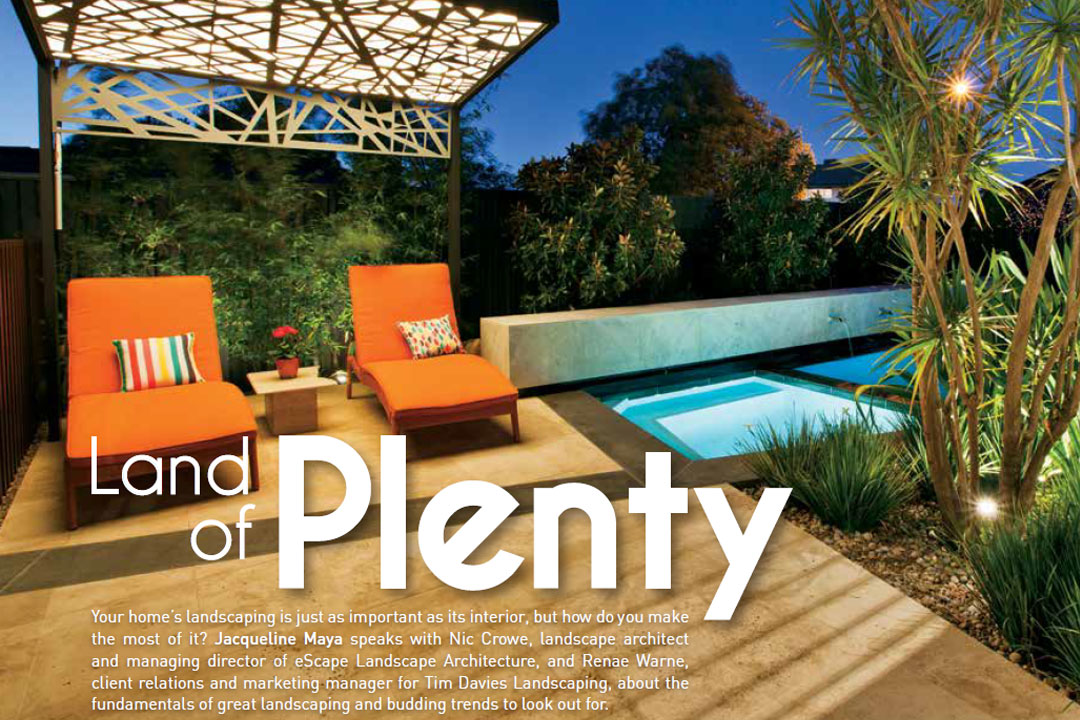
Land Of Plenty
Simply put, landscaping at its core is about creating or improving outdoor spaces through design. Renae Warne says that “landscaping is often mistaken as being ‘just plants’, [but] it actually encompasses every element outside of the home”.
An outdoor space can be improved in all kinds of ways, from changing its shape and establishing edible or decorative plants, to adding structures like fences, patios or decks.
Common landscaping spaces and elements include alfresco dining areas, decking, driveways, garden lighting, pergolas, pools and cabanas, as well as sculptures, outdoor showers, retaining walls and water features.
Balancing Act
So what’s the secret to a well-balanced garden? According to Nic Crowe, it’s “a combination of quality design and advice [on the] orientation of spaces and design principles, [from the initial design stages through to] construction”.
The elements of balance, colour, line, repetition, simplicity and unity all play a part in creating a harmonious landscape. According to Crowe, “form, function, texture, plant selection, scale, and sense of place [are equally important, and] help the designer to create unique designs in consultation with the clients”.
Be Prepared
No matter your project’s size, Crowe and Warne both recommend engaging your landscape designer as early as possible. Be sure to start thinking about the following logistical and design aspects before embarking on your project.
Business Location: Is the landscaping business you’re considering locally owned and operated?
Close proximity to your designer/builder is often crucial for optimum efficiency and ease of communication.
Colours: Which colour scheme will you use? Monochromatic landscapes use variations of a single tone, and can be achieved with ornamental grasses and succulents. By contrast, complementary gardens use pigments that sit opposite each other on the colour wheel. Bright-green ferns and red-barked dogwood are excellent complementary plants. As another alternative, analogous palettes use plants and perennials with similar hues, such as different varieties of marigold.
Construction: Does the company use its own staff for construction projects or does it outsource? Local tradespeople who are familiar with the area and local climate can more easily provide suitable recommendations.
Cost: Do you have a strict budget, or are you happy to revaluate your spend bracket for that standout item?
Existing Elements: What do you like about the current space that you want to integrate into the new design?
Essential Items: Where will housework and gardening items be stored? Thinking early on about those essential elements – such as the clothesline and toolbox – will save you time later.
Occupancy: How long do you expect to occupy the property? This will affect the materials you should choose for your landscaping, and the amount of money you should invest.
Pets: Do you have or plan to have pets? If so, select hardy plants like larger shrubs, trees and
perennials, as they’re more likely to survive the curiosity of your pooch.
Space: How do you want to use your outdoor area? Will it be used for everyday purposes such as dining, or will it be primarily scenic?
Time: How much time do you have to maintain the landscaping? Choosing a design that requires a high level of maintenance might not be suitable if you’re time-poor. It’s important to be realistic.
Who: Who will be living in the residence? It is important that everyone in your household can enjoy the space. For example, be sure to incorporate some play areas and fun hideyholes if you have children.
Sewing the Seeds
Now it’s time to learn about the landscaping design process, in which you – as the homeowner – will play a pivotal role.
The length of time it will take to complete a project will largely depend on the scope of the works and the complexity of the design. The first meeting with your designer is vital for exploring possibilities and expectations, and determining the brief for the project. “We always forge strong working relationships with our clients, which allows us to develop a common vision for the project,” Crowe says.
Similarly, Warne says “you should start [by having] a detailed conversation with your landscape architect, followed by clear communication throughout the [rest of the] design process”.
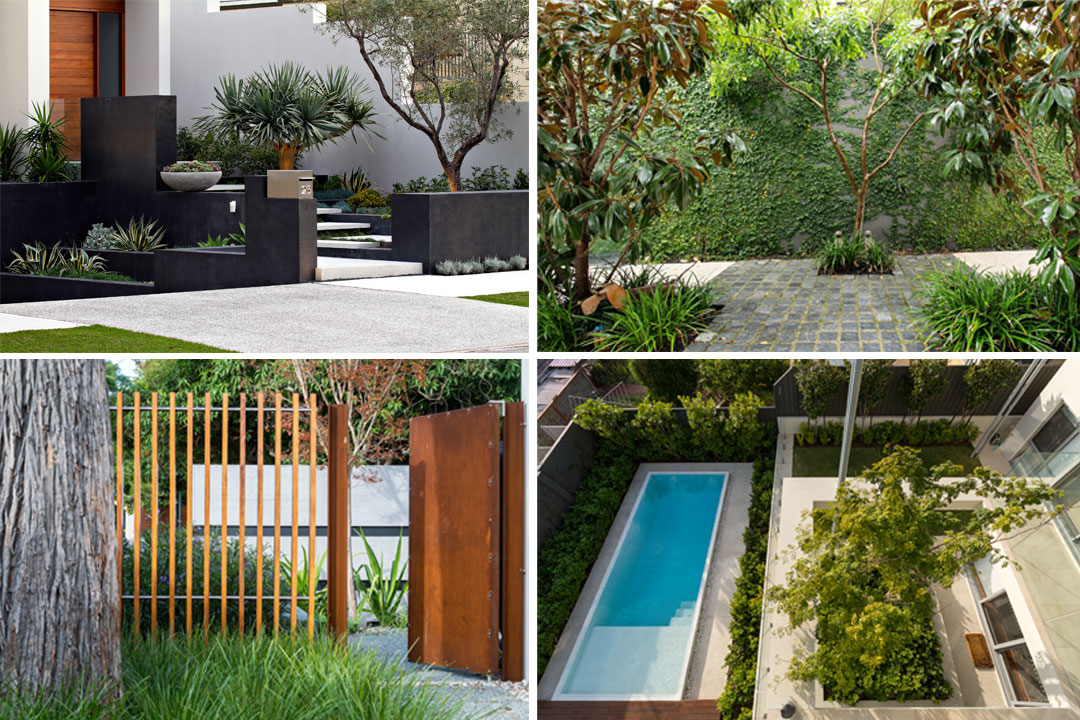
Once the vision for the project has been agreed upon, the next important step is to put detailed thought into the various aspects of your site. “Every site has a unique sense of place and fits into the wider context of the [surrounding] environment,” Crowe says.
There’s an extensive list of specific site elements that your designer will look out for. These include aspect, orientation, built form and house design, climactic conditions, drainage, existing site features, irrigation, levels and retaining solutions, location, council regulations and building codes, opportunities and constraints, as well as soil type and service easements.
The designer will meet with you to discuss the design concept, which will be made clearer with images, plans, sketches and 3D models. They will then further develop and refine the concept design until a final drawing is made, which will be ready for quotation. Once they have received all the relevant approvals, the construction of your project can begin!
Good Green Fun
Warne says it’s crucial to implement sustainable designs and construction practices into your landscaping project from the outset, while also choosing eco-friendly maintenance solutions once it’s completed. A sustainable outdoor area should be functional, cost-effective, visually pleasing, environmentally friendly and – most importantly – maintainable.
To implement sustainable design practices, Warne suggests thinking about the management of stormwater runoff, the reduction of water use and the inclusion of climate-appropriate plants. Try using grey water for irrigation and select an energy-efficient design that pays attention to the location and selection of shade trees. Include some windbreaks, and take care to recycle and repurpose materials where possible. Consider using kitchen waste to make compost and improve soil structure.
With a focus on sustainable landscaping practices, Crowe and the team at eScape Landscape Architecture also have extensive experience providing native and water-wise plants for any given design.
Crowe provides clients with a comprehensive handover package, which outlines the best methods to care for the gardens that eScape Landscape Architecture designs and constructs. “Regular maintenance will yield the best results and as a bonus, [you’ll be more motivated to] spend time outside with family,” he says.
Fashionable Flora
Warne says the main landscaping styles that are frequently used include formal, informal, contemporary, urban, industrial, country, environmental and sustainable. “Each of these styles have aspects that make them uniquely suited to different climates, personalities [and] architectural styles,” she says.
For example, varieties of palms, anthuriums and gingers are ideal for creating a tropical oasis.
Warne has noticed that landscapes – whether large or small – often intertwine different styles for a beautiful effect. A range of climactic themes have also become popular, such as tropical, Mediterranean, temperate and alpine.
While trends come and go, Warne says that gardens tend to reflect the style of the home and should be timeless in their design. “Landscaping should be an extension of the architecture,” she says. “The chosen finishes, colours, textures and materials have to work into the [broader] visual landscape.”
Crowe expects that Perth homeowners will continue to enjoy spending time in their gardens, pools and alfresco barbecue areas, and will invest in these spaces for years to come. Now that you’ve learnt about landscape design from the ground up, it will be easier to create your perfect outdoor area. Ready, set, grow!